Cheapest Flights Within K Stops
Problem
There are n airports, labeled from 0 to n - 1, which are connected by some flights. You are given an array flights where flights[i] = [from_i, to_i, price_i] represents a one-way flight from airport from_i to airport to_i with cost price_i. You may assume there are no duplicate flights and no flights from an airport to itself.
You are also given three integers src, dst, and k where:
srcis the starting airportdstis the destination airportsrc != dstkis the maximum number of stops you can make (not includingsrcanddst)
Return the cheapest price from src to dst with at most k stops, or return -1 if it is impossible.
Examples
Example 1:
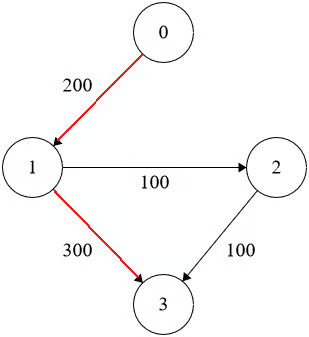
Input: n = 4, flights = [[0,1,200],[1,2,100],[1,3,300],[2,3,100]], src = 0, dst = 3, k = 1

Output: 500
Explanation:
The optimal path with at most 1 stop from airport 0 to 3 is shown in red, with total cost 200 + 300 = 500.
Note that the path [0 -> 1 -> 2 -> 3] costs only 400, and thus is cheaper, but it requires 2 stops, which is more than k.
Example 2:
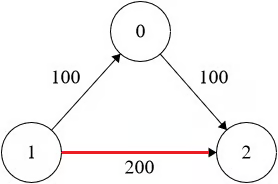
Input: n = 3, flights = [[1,0,100],[1,2,200],[0,2,100]], src = 1, dst = 2, k = 1

Output: 200
Explanation:
The optimal path with at most 1 stop from airport 1 to 2 is shown in red and has cost 200.
Constraints
1 <= n <= 100fromi != toi1 <= pricei <= 10000 <= src, dst, k < n
You should aim for a solution as good or better than O(n + (m * k)) time and O(n) space, where n is the number of cities, m is the number of flights, and k is the number of stops.
Solution
DFS works but has exponential number of paths. We are told the upper bound on number of flights/steps, so DP should be natural here.
- If no limit on the number of steps and all price are non-negative, use Dijkstra (ordinary shortest path)
- If we need all possible routes, then DFS is a better fit
class Solution {
public:
    int findCheapestPrice(int n, vector<vector<int>>& flights, int src, int dst, int k) {
        const auto INF = std::numeric_limits<int>::max();
        // Cheapest known price to reach city using at most current iter number of flights
        std::vector<int> distances(n, INF);
        distances[src] = 0;
        // Use DP, each around allows us to use one more flight
        // Round i: cheapest prices using at most i flights
        // k stops means k+1 flights, so use equality on loop condition
        for (int i = 0; i <= k; ++i) {
            std::vector<int> next_distances = distances;
            for (const auto &flight : flights) {
                int from = flight[0];
                int to = flight[1];
                int cost = flight[2];
                if (distances[from] == INF) {
                    continue;
                }
                next_distances[to] = std::min(next_distances[to], distances[from] + cost);
            }
            distances = std::move(next_distances);
        }
        return distances[dst] == INF ? -1 : distances[dst];
    }
};