Convolutional Networks
Convolutional layers are specialized network components which are mainly used for processing image data. Images have some properties that suggest the need for specialized model architecture
- They are high-dimensional. Hidden layers in fully connected networks that would process image inputs would be prohibitive in memory and compute costs to handle the number of weights
- Nearby image pixels are statistically related. Fully connected networks have no notion of nearby.
- The interpretation of an image is stable under geometric transformations (translation, etc.). A fully connected model must learn the patterns of pixels that signify a tree separately at every position.
Definition (Convolutional Neural Network)
A network predominantly consisting of convolution layers is known as a convolutional neural network or *CNN.
Invariance and Equivariance
Definition (Invariant)
A function
of an image is invariant to a transformation if
In other words, the output of the function
Definition (Equivariant or Covariant)
A function
of an image is equivariant or covariant to a transformation if
In other words,
Convolutional Networks for 1D Inputs
Definition (Convolutional Layer)
Convolutional layers are network layers based on the convolution operation. In 1D, a convolution transforms an input vector
into an output vector so that each output is a weighted sum of nearby inputs. The same weights are used at every position and are collectively called the convolution kernel or filter. The size of the region over which inputs are combined is termed the kernel size. For a kernel size of three, we have where
is the kernel.
Notice that the convolution operation is equivariant with respect to translation. If we translate the input
Padding
The convolution equation begs the question of how to deal with the first output (where there is no previous input) and the final output (where there is no subsequent input). There are two common approaches:
- Pad the edges of the input with new values and proceed as usual. Zero-padding assumes the input is zero outside its valid range.
- Discard the output positions where the kernel exceeds the range of the inputs. These valid convolutions have the advantage of introducing no extra information at the edges of the input. However, they have the disadvantage that the representation decreases in size.
Stride, Kernel Size, and Dilation
Convolution operations are a family, which are defined by the following attributes:
- Kernel Size/Filter Size: The dimension of the sliding window over the input. A larger kernel size can cover a larger spatial area of the input. It is typically kept as an odd number so that it can be centered around the current position
- Stride: How many inputs pixels the kernels should be shifted over at a time. If we have a stride of two, we create roughly half the number of outputs.
- Dilation Rule: The number of zeros interspersed between the weights plus one
Convolutional Layers
A convolutional layer computes its output by convolving the input, adding a bias
which is a special case of a fully connected layer.
Channels
If we only apply a single convolution, information will likely be lost; we are averaging nearby inputs, and the ReLU activation function clips results that are less than zero. Hence, it is usual to compute several convolutions in parallel. Each convolution produces a new set of hidden variables, termed a feature map or channel.
In general, the input and hidden layers all have multiple channels. If the incoming layer has
Intuition
For each output channel, the spatial output is a linear combination of the
inputs plus bias, passed through an activation function. This is repeated for each spatial output. Each output channel gives a new set of weights.
Receptive Fields
Definition (Receptive field)
The receptive field of a hidden unit in the network is the region of the original input that feeds into it.
For a stack of
This reflects that the first layer sees
Convolutional Networks for 2D Inputs
Convolutional layers can be applied to 2D image data. The convolutional kernel is now a 2D object.
If a kernel is size
For input
The weight tensor is of size
Intuition
Without padding, the representation gets reduced in height and width for every convolution layer. As a result, the receptive field gets larger. Padding still results in the receptive field increasing at the same rate, but also allows the representation to remain the same size if chosen correctly.
Conv2D Implementation
Naive Implementation
Each thread computes a single element in the result tensor by performing a convolution over a
constexpr int TW = 32;

template <typename T>
__global__ void conv_forward(
    const T *X, const T *W, T *Y,
    int W_grid, int C_in, int C_out, int H_in, int W_in,
    int K, int S, int P
) {
    int b = blockIdx.x;
    int m = blockIdx.y;
    int h = (blockIdx.z / W_grid) * TW + threadIdx.y;
    int w = (blockIdx.z % W_grid) * TW + threadIdx.x;
    const int H_out = (H_in + 2 * P - K) / S + 1;
    const int W_out = (W_in + 2 * P - K) / S + 1;
    T sum = 0;

    const int flat_size_in = C_in * H_in * W_in;
    const int flat_size_out = C_out * H_out * W_out;
    const int idx_res = b * flat_size_out + m * (H_out * W_out) + h * (W_out) + w;

    for (int c = 0; c < C_in; ++c) {
        for (int p = 0; p < K; ++p) {
            for (int q = 0; q < K; ++q) {
                int h_in = S * h + p - P;
                int w_in = S * w + q - P;
                int idx_in = b * flat_size_in + c * (H_in * W_in) + (h_in * W_in) + w_in;
                int idx_w = (m * C_in * K * K) + (c * K * K) + (p * K) + q;
                T X_val = (h_in < 0 || w_in < 0 || h_in >= H_in || w_in >= W_in) ? 0 : X[idx_in];
                sum += X_val * W[idx_w];
            }
        }
    }
    Y[idx_res] = sum;
}
...
const int H_out = (H_in + 2 * P - K) / S + 1;
const int W_out = (W_in + 2 * P - K) / S + 1;
int W_grid = ceil_div(W_out, TW);
int H_grid = ceil_div(H_out, TW);

dim3 blockDim(TW, TW, 1);
dim3 gridDim(B, C_out, W_grid * H_grid);
conv_forward<<<gridDim, blockDim>>>(dev_X, dev_W, dev_Y, B, C_in, C_out, H_in, W_in, K, S, P);
Conv2D as Matrix Multiplication
A Conv2D can be implemented as a matrix multiplication. The weight tensor of shape im2col.
The matrix product therefore has shape
which can then be reshaped back into the output tensor.
Caution
While this method utilizes fast matrix multiplication kernels, it requires explicitly storing the unrolled matrix
, which has entries instead of the original input entries. For stride one with roughly equal input and output spatial sizes, this is approximately a factor of more memory.
Downsampling and Upsampling
While we’ve seen that the representation size can decrease as it passes through convolution layers, there are additional layer types to scale down and up the representation
Downsampling
There are several ways to downsample a representation using convolutional layers
- We can sample every other position by using a stride of 2
- Max Pooling retains the maximum of the 2x2 input values
- Mean Pooling retains the average of the 2x2 input values
Upsampling
There are several ways to upsample a representation using convolutional layers:
- To double the resolution, one can duplicate all the channels at each spatial positions four times
- Max Unpooling will distribute the values to the positions they originated from
- Bilinear interpolation to fill in the missing values between points where we have samples
- Transposed Convolution has twice as many outputs as inputs, and each input contributed to three of the outputs.
Changing the Number of Channels
Sometimes we want to change the number of channels between one hidden layer and the next without further spatial pooling. This is usually so we can combine the representation with another parallel computation. To accomplish this, we apply a convolution with kernel size one. Each element of the output layer is computed by taking a weighted sum of all the channels at the same position. We can repeat this multiple times with different weights to generate as many output channels as we need. The associated weights have size
Applications
Image Classification
Most methods reshape the input images to a standard size (say 224x224 RGB), and the output is a probability distribution over classes. Typically, convolution layers and pooling layers are interleaved with the spatial resolution decreasing and number of channels increasing. The representation is then reshaped/flattened, passed through fully connected layers, then a softmax to produce probabilities for each class.
Object Detection
The YOLO network rescales the input to a 448x448 RGB image and processes it with convolutional layers to produce a coarse 7x7 spatial grid of features. Each grid cell is responsible for objects whose center falls inside that cell, and the network predicts both class probabilities and a small fixed number of candidate bounding boxes per cell. Each bounding box is described by its center
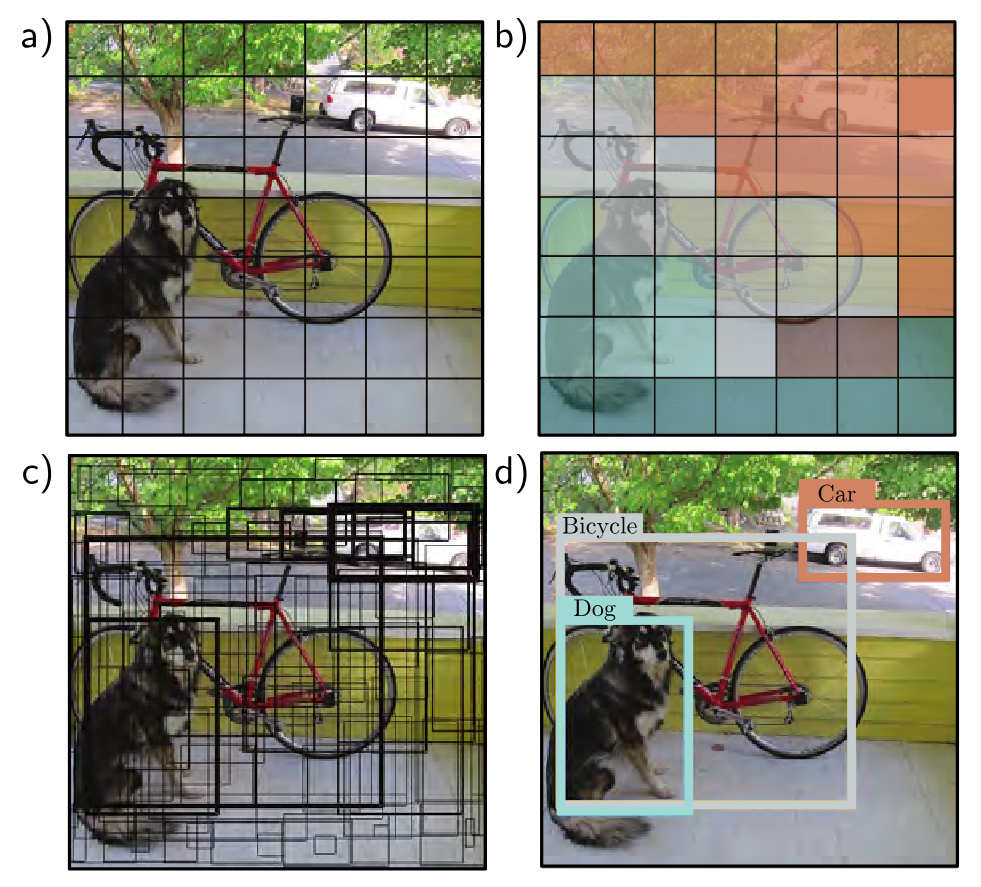
After prediction, low-confidence boxes are discarded and overlapping boxes for the same object are reduced using non-maximum suppression, leaving only the most confident detections.
Semantic Segmentation
The goal of segmentation is to assign a label to each pixel according to the object that it belongs to or no label if that pixel does not corresponding to anything in the training set. An example network passes the input image through convolutional layers, which reduce the spatial size but increase the number of channels. The representation is then flattened and passed into a fully connected layer. This then transformed back into a representation of size 7x7x512, and passed through max unpooling layers until the spatial shape matches the original input, but with channels representing one of each of the segmentation classes.
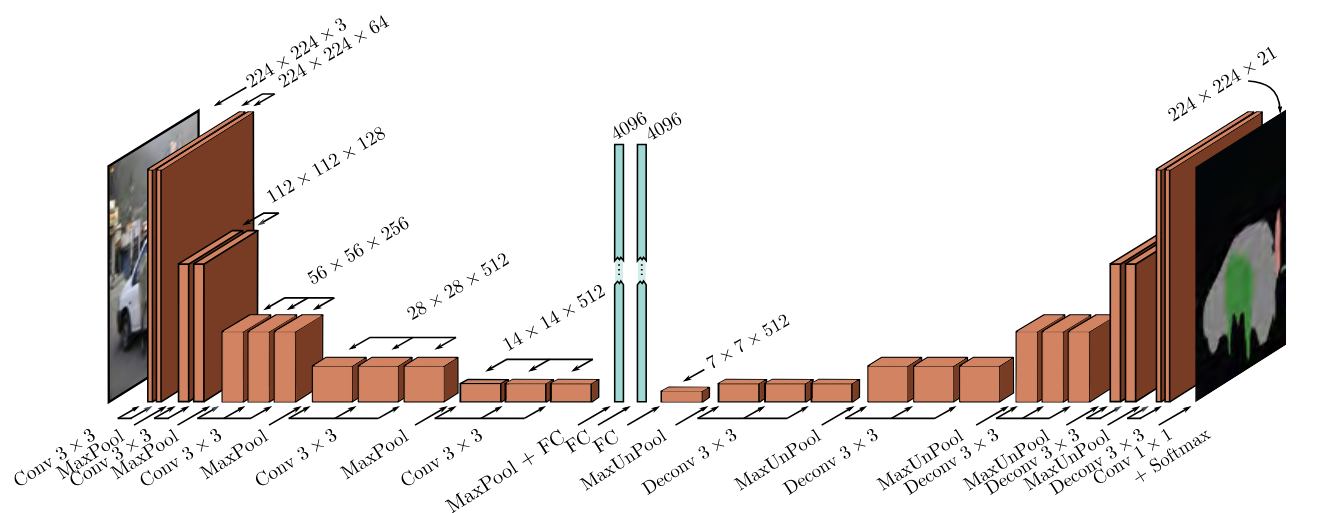
These two downscaling and upscaling models can be referred to as an encoder and decoder.
Additional Readings
Sources
- Prince, S. (2023). Understanding Deep Learning. Chapter 10.