Graph Neural Networks
As the name suggests , graph neural networks are neural architectures that process graphs (sets of nodes connected by edges). There are three novel challenges associated with processing graphs:
- Their topology is variable, and its hard to design networks that are both sufficiently expressive and can cope with this variation.
- Graphs may be enormous (billions of nodes).
- There may only be a single monolithic graph available, so the usual protocol of training with many data examples and testing with new data is not always appropriate.
Graph Representations
A graph consists of a set of
- The
th node has an associated node embedding of length . These embeddings are concatenated and stored in the node data matrix . - Similarly, the
th edge has an associated edge embedding of length . These edges embeddings are collected into the matrix .
Properties of the Adjacency Matrix
Consider encoding the
Caution
This is not the same as the number of unique paths since the walks include routes that visit the same node more than once.
Permutation of Node Indices
Node indexing in a graphs is arbitrary; permuting the node indices results in a permutation of the columns of the node data matrix
where post-multiplying by
Graph Neural Networks, Tasks, and Loss Functions
Definition
A graph neural network is a model that takes the node embedding
and the adjacency matrix as inputs ans passes them through a series of layers. The node embeddings are updated at each layer to create intermediate hidden representations before finally computing the output embedding .
At the start of the network, each column of the input node embeddings
Tasks and Loss Functions
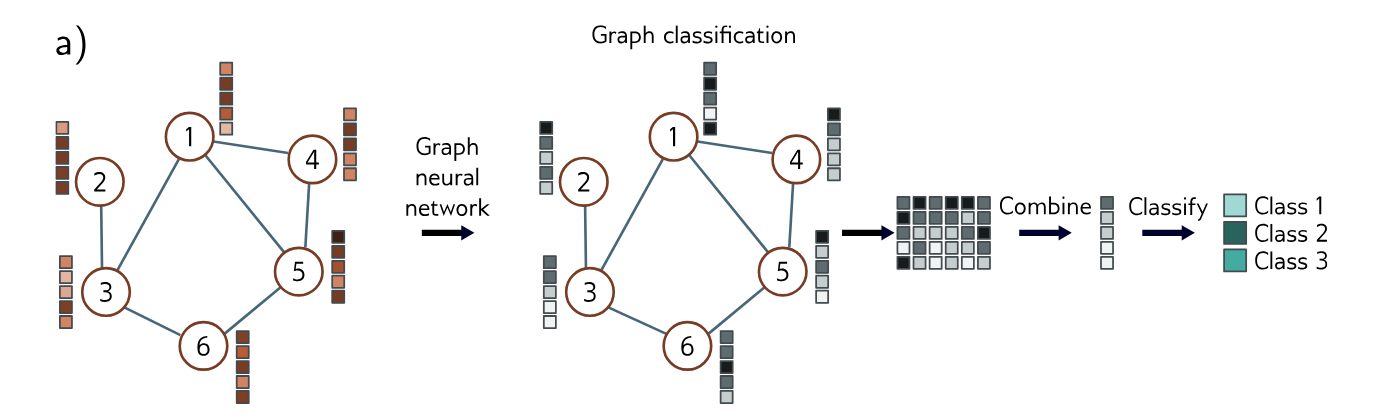
Graph-Level Tasks
The network assigns a label or estimates one or more values from the entire graph, exploiting both the structure and node embeddings. For example, we might want to predict the temperature at which a molecule becomes a liquid (regression task) or whether a molecule is poisonous to human beings or not (classification task).
For graph-level tasks, the output node embeddings are combined (by averaging), and the resulting vector is mapped via a linear transformation or neural network to a fixed-sized vector. For example, in binary classification, the output is passed through a sigmoid function, and the mismatch is calculated using the binary cross-entropy loss. Here, the probability that the graph belongs to class one might by given by
where the scalar
Node-Level Tasks
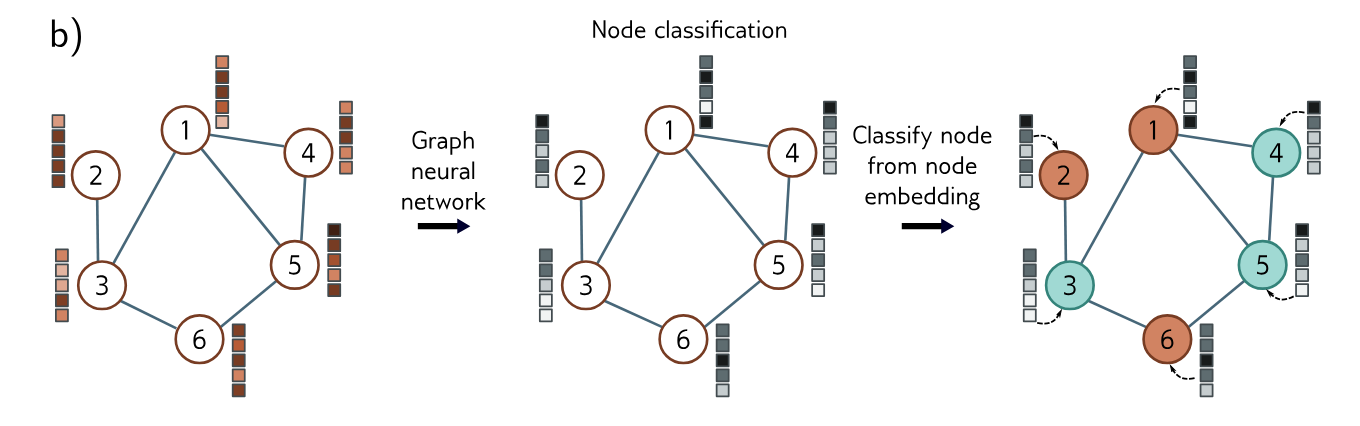
The network assigns a label (classification) or one or more values (regression) to each node of the graph, using both the graph structure and node embeddings. For example, given a graph constructed from a 3D point cloud, the goal might be to classify the nodes according to whether they belong to the wings or fuselage. Loss functions are defined in the same way as for graph-level tasks, except for now this is done independently for each node
Edge Prediction Tasks
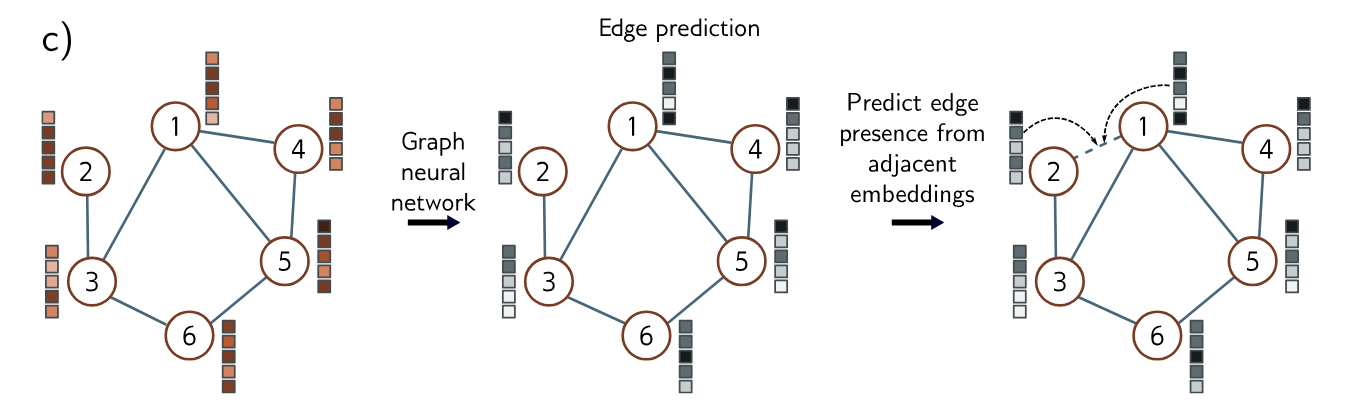
The network predicts whether or not there should be an edge between nodes
Graph Convolutional Networks (GCNs)
These models are convolutional in that they update each node by aggregating information from nearby nodes. As such, they induce a relational inductive bias (i.e. a bias towards prioritizing information from neighbors). They are spatial-based because they use the original graph structure.
Each layer of the GCN is a function
where
Equivariance and Invariance
The indexing of the nodes in the graph is arbitrary, and any permutation of the node indices does not change the graph. It is hence imperative that any model respects this property. It follows that each layer must be equivariant with respect to permutation of node indices. If
For node classification and edge prediction tasks, the output should also be equivariant with respect to permutations of the node indices. However, for graph-level tasks, the final layer aggregates information from across the graph, so the output is invariant to the node order.
Parameter Sharing
Convolutional layers are applied to images that processed every position in the image identically. This reduced the number of parameters and introduced an inductive bias that forced the model to treat every part of the image in the same way. The same argument can be made about nodes in a graph. While in images we have a fixed-size square region around the current position when considering neighbors, in a graph each node may have a different number of neighbors, and there are no consistent relationships. There is no sense that we can weight information from a node that is above the node of interest differently to information from a node below it.
GCN Layer
These considerations lead to a simple GCN layer.
Definition
At each node
in layer , we aggregate information from neighboring nodes by summing their node embeddings : where
returns the set of indices of the neighbors of node . Then we apply a linear transformation to the embedding at the current node and to this aggregated value, add a bias term , and pass the result through a nonlinear activation function , which is applied independently to every member of its vector argument: We can write this more succinctly by noting that post-multiplication of a matrix by a vector returns a weighted sum of its columns. The
th column of the adjacency matrix contains ones at the positions of the neighbors. Hence, if we collect the node embeddings into the matrix and post-multiply by the adjacency matrix , the th column of the result is . The update for the nodes is now where
is an vector containing ones and are the layer parameters. Here, the nonlinear activation function is applied independently to every member of its matrix arguments.
This satisfies the design considerations:
- it is equivariant to permutations of the node indices,
- can cope with neighbors,
- exploits the graph structure to provide a relational inductive bias,
- and shared parameters throughout the graph.
Training Considerations
Given
However, we can use the a trick by treating the graphs in the batch as disjoint components of a single large graph. The network can then be run as a single instance of the network equations.
Layers for Graph Convolutional Networks
The GCN combined messages from adjacent nodes by summing them together with the transformed current node. This was accomplished by post-multiplying the node embedding matrix
Combining Current Node and Aggregated Neighbors
Definition (Diagonal Enhancement)
In another variation, the current node is multiplied by a factor of
before contributing to the sum, where is a learned scalar that is different for each layer: This is known as diagonal enhancement. A related variation applied a different linear transform
to the current node: where
.
Residual Connections
Definition (Residual Connections)
With residual connections, the aggregated representation from the neighbors is transformed and passed through the activation function before summation or concatenation with the current node. For the latter case, the associated network equations are
Mean Aggregation
The above methods aggregate the neighbors by summing the node embeddings. However, its possible to combine the embeddings in different ways. Sometimes its better to take the average of the neighbors rather than the sum. This can be superior if the embedding information is more important and the structural information less so since the magnitude of the neighborhood contributions will not depend on the number of neighbors.
Definition (Mean Aggregation)
Mean Aggregation is given by
where as before,
denotes a set containing the indices of the neighbors of the th node. The above can be computed in matrix form by introducing the diagonal degree matrix . Each non-zero element of the matrix contains the number of neighbors for the associated node. It follows that each diagonal element in the inverse matrix contains the denominator that we need to compute the average. The new GCN layer can be written as
Kipf Normalization
There are many variations of graph neural networks based on mean aggregation. Sometimes the current node is included with its neighbors in the mean computation rather than treated separately.
Definition (Kipf Normalization)
In Kipf normalization, the sum of the node representations is normalized as
with the logic that information coming from nodes with a very large number of neighbors should be down-weighted since there are many connections and they provide less unique information. This can also be expressed in matrix form using the degree matrix:
Max Pooling Aggregation
An alternative operation that is invariant to permutation is computing the maximum of a set of objects.
Definition (Max Pooling Aggregation)
The max pooling aggregation operator is
where the operator
returns the element-wise maximum of the vectors that are neighbors to the current node .
Aggregation by Attention
The aggregation methods discussed so far either weight the contribution of the neighbors equally or in a way that depends on the graph topology. Conversely, in graph attention layers, the weights depend on the data at the nodes.
Definition (Graph Attention Layer)
A linear transform is applied to the current node embeddings so that
Then the similarity
of each transformed node embedding to the transformed node embedding is computed by concatenating the pairs, taking a dot product with a column vector of learned parameters, and applying an activation function These variables are stored in an
matrix , where each element represents the similarity of every node to every other. As in dot-product self attention, the attention weights contributing to each other embedding are normalized to be positive and sum to one using the softmax operation. However, only those values corresponding to the current node and its neighbors should contribute. The attention weights are applied to the transformed embeddings: where
is a second activation function. The function computes the attention values by applying softmax operation separately to each column of its first argument , but only after setting values where the second augment is zero to negative infinity, so they do not contribute. This ensures that the attention to non-neighboring nodes is zero.
This is similar to the dot-product self-attention computation in transformers, except that:
- The keys, queries, and values are all the same
- The measure of similarity is different
- The attentions are masked so that each node only attends to itself and its neighbors.
As in transformers, this system can be extended to use multiple heads that are run in parallel and recombined.
Sources
- Prince, S. (2023). Understanding Deep Learning. Chapter 13.
- Graph Attention Networks